
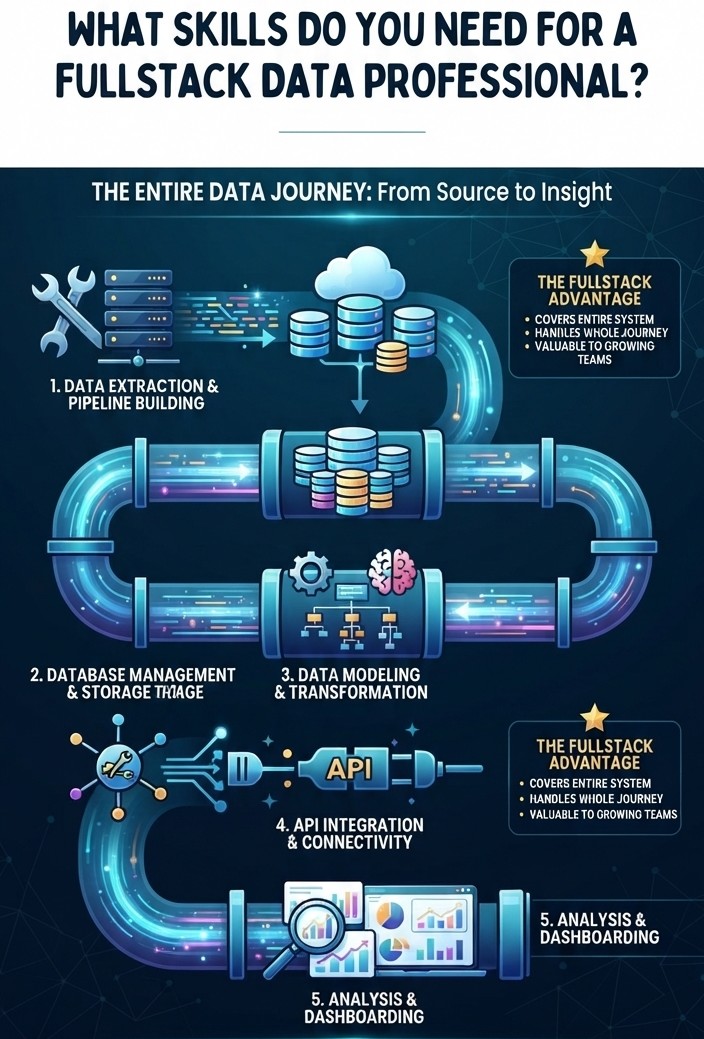
 Data doesn't arrive ready to analyse, it has to be extracted, stored properly, connected across systems, and modelled before anyone can build a dashboard from it. Fullstack data careers cover that entire journey, not just the analysis at the end.
What Makes This a "Fullstack" Skill Set
The term borrows from software development, where "fullstack" means someone comfortable working across an entire system rather than just one layer. Applied to data, it means someone who can build a pipeline pulling data from its source, manage the database it lives in, connect it to other systems through APIs, and ultimately turn it into a usable dashboard, rather than specialising narrowly in just analysis or just infrastructure.
This breadth makes the role genuinely valuable to smaller or growing companies especially, where hiring five specialists for each piece of the data pipeline isn't realistic, but one person who can handle the whole journey is.
The Skills That Make Up the Full Stack
Data pipeline building is foundational, learning to move data reliably from its source into a usable system. Database management teaches you to structure and maintain the storage layer data actually lives in.
API integration connects systems together, pulling and pushing data between tools that need to talk to each other. Data modeling and dashboard development close the loop, structuring data logically and presenting it in a way that's genuinely useful to decision-makers
How VAA Global's Fullstack Data Course Builds This
VAA Global's Fullstack Data course runs 10 weeks, covering data pipeline building, database management, API integration, data modeling, and dashboard development, using Python, SQL, Power BI, and Google Cloud.
You'll build a real, end-to-end data project across the course, giving you tangible proof of working across the full data stack, not just one narrow slice of it. Every VAA Global course includes a 2-month internship, 2 certificates, and job placement assistance.
Why End-to-End Data Skills Are Valued
Gartner's ongoing data and analytics research has repeatedly noted that organisations increasingly need versatile data talent capable of working across the full data lifecycle, not just siloed specialists, particularly as smaller and mid-sized companies build out their data capabilities without large dedicated teams.
If you'd rather start narrower before going broad, Data Analysis is a strong, more focused starting point, or take the free Career Compass quiz to compare.
Common Mistakes Beginners Make in This Field
A common beginner mistake is building a pipeline without properly considering what happens when something breaks, a data source changes format, a connection fails, which leaves you troubleshooting under pressure rather than having designed for resilience from the start.
A second mistake is over-engineering a database structure before actually understanding how the data will genuinely be used, adding unnecessary complexity that makes the system harder to maintain without adding real value.
A third mistake is neglecting documentation, building a system that works but that nobody else, including your future self, can easily understand or maintain months later. Clear documentation is unglamorous but genuinely essential in end-to-end data work.
What Your First Few Weeks Actually Look Like
Early weeks in VAA Global's Fullstack Data course focus on data pipeline fundamentals and database management, the infrastructure layer everything else depends on.
The middle weeks bring in API integration and data modeling. The final weeks tie everything into dashboard development on a complete, end-to-end project, before the 2-month internship gives you real infrastructure work to contribute to.
Beyond the technical skills, this path also rewards a genuine systems-thinking mindset, understanding how a change in one part of a data pipeline ripples through everything downstream, which is exactly the kind of holistic understanding that develops through building complete, end-to-end projects rather than isolated exercises.
This holistic thinking is also exactly why fullstack data skills remain valuable even as AI tools increasingly assist with individual coding tasks, since understanding how an entire system fits together is a genuinely different, more durable skill than writing any single piece of code.
This same holistic thinking is also exactly why fullstack data professionals often transition smoothly into broader technical leadership roles later, since they've already built the habit of seeing how individual pieces of a system connect to the whole, a perspective that becomes increasingly valuable as responsibilities grow.
Once you're genuinely job-ready, VAA Global Talent at talent.vaaglobal.tech connects graduates directly with employers actively hiring for exactly this kind of skill.
VAA Global's free CV and LinkedIn review tool at vaaglobal.tech/cv-review can also help you present this experience clearly once you're ready to apply.
World Economic Forum Future of Jobs Report has tracked this pattern closely, and their findings reinforce exactly the point made here.
According to National Association of Colleges and Employers (NACE), this trend has held steady across multiple years of tracking, not just a short-lived shift.
Building Your Fullstack Data Career
This path rewards people who like understanding a whole system, not just one piece of it. If that's you, you can apply to VAA Global's Fullstack Data course.