You'll hear the word 'control' constantly once you start reading about GRC, often without a clear definition attached — so let's fix that. Understanding what is a control in GRC is foundational, because almost every framework you'll encounter, from COSO to ISO 27001, is ultimately built around identifying, implementing, and testing controls.
A Control vs. a Policy: Not the Same Thing
A policy is a written statement of intent — 'all employees must use strong passwords.' A control is the actual mechanism that enforces or verifies that intent, like a system that rejects weak passwords automatically, or a periodic audit that checks whether passwords meet the policy. Beginners often conflate the two, but a policy with no supporting control is really just a hope, not an enforced practice.
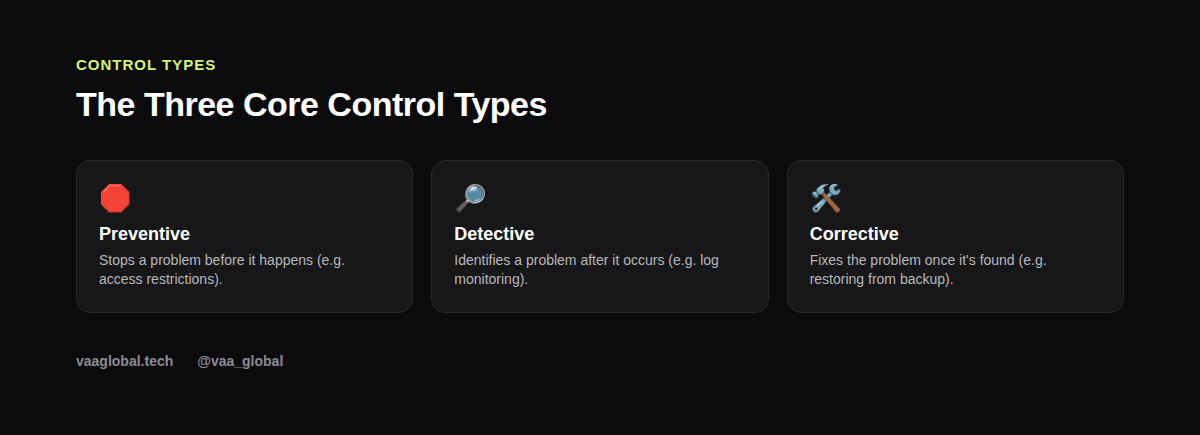
The Three Core Control Types
Controls generally fall into three types, shown in the graphic above. Preventive controls stop a problem before it happens — think access restrictions or input validation. Detective controls identify a problem after it's already occurred — think log monitoring or reconciliation reviews. Corrective controls fix the problem once it's found — think restoring from backup or revoking compromised credentials. Strong programs use all three together rather than relying on just one type.
Manual vs. Automated Controls
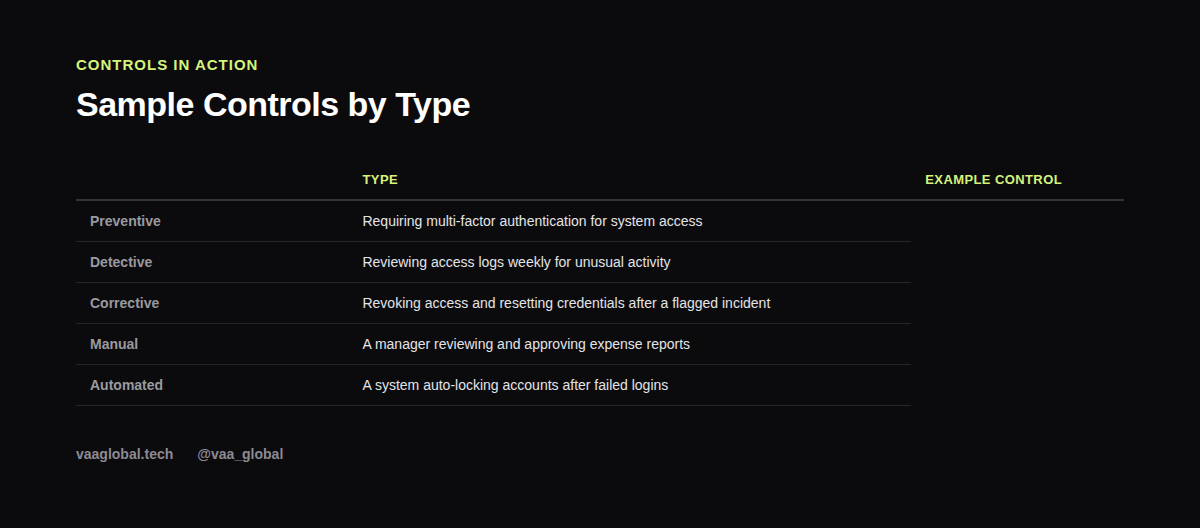
Controls can also be classified by how they're carried out. A manual control depends on a person actively doing something, like a manager reviewing and approving an expense report. An automated control runs without a human in the loop each time, like a system that locks an account after repeated failed login attempts. Automated controls tend to be more consistent, since they don't depend on someone remembering to act, but manual controls are often faster to set up and still essential for judgment calls a system can't make.
Control Owners: Who's Actually Responsible
Every control should have a control owner — a specific person or role accountable for making sure it actually works, not just that it's documented. Without clear ownership, controls tend to quietly decay: a review that was happening weekly slips to monthly, then stops altogether, and nobody notices until an audit or incident exposes the gap.
Control Testing: How You Know It's Actually Working
Just because a control is documented doesn't mean it's effective. Control testing — sampling evidence, re-performing a process, or reviewing logs — is how auditors and GRC teams verify that a control operates as intended. This is exactly the kind of testing that happens during a SOC 2 Type II audit or an ISO 27001 internal audit, and it's also how teams discover a control gap: a risk that either has no control at all, or has one that isn't actually functioning.
A Worked Example
Take the risk of unauthorized access to customer data. A preventive control might require role-based access permissions, so only people who need the data can see it. A detective control might review access logs monthly for unusual patterns. A corrective control might immediately revoke access and investigate whenever something unusual is confirmed. Together, these three controls address the same risk from different angles, which is exactly the kind of layered thinking a risk register entry should reflect once it's fully treated.
Common Questions Beginners Ask
People often ask what are the different types of controls — preventive, detective, and corrective, and separately, manual versus automated, as covered above. On is a policy the same as a control, no — a policy states intent, a control enforces or verifies it. People also ask how do you know if a control is working, which comes down to testing it with real evidence rather than assuming documentation equals execution. And who owns a control in a company — typically whoever is closest to actually performing or managing the activity the control governs, formally named as the control owner.
Control Gaps and How They're Found
A control gap exists when a known risk has no control attached to it, or has a control that looks fine on paper but fails under testing. Gaps usually surface during an internal audit, a SOC 2 or ISO 27001 assessment, or sometimes painfully, after an actual incident exposes the hole. The fastest-growing GRC teams tend to be the ones that catch gaps proactively, through regular control testing, rather than waiting for an external audit or a bad outcome to reveal them. This is part of why third-party vendor risk management programs ask vendors directly about their own control environments before signing a contract.
Why This Matters for Your Career
Controls are the building blocks of nearly every GRC framework, so understanding them deeply gives you a transferable skill across ISO 27001, SOC 2, COSO, and beyond. If you're building your foundational knowledge, pairing this with our guides on what is a risk register and how to build one, the COSO framework explained simply, and third-party vendor risk management basics will round out your understanding of how controls fit into the bigger risk picture. For the formal definitions used in internal control work, coso.org is a solid authoritative reference.
The Bottom Line
When someone asks what is a control in GRC, the short version is: it's the actual mechanism, not just the intention, that keeps a specific risk in check. Learn to spot preventive, detective, and corrective controls in the wild, and you'll start seeing the same underlying logic in every compliance framework you read next.