Modern companies rely on dozens, sometimes hundreds, of outside vendors — which is exactly why third-party vendor risk management basics have become such a core GRC skill. Every vendor you hand data or system access to is, in a real sense, an extension of your own risk surface.
Why Vendor Risk Deserves Its Own Attention
A company can have excellent internal security and still get badly hurt by a vendor's weak practices — a breached payroll provider, a cloud host with poor access controls, or a subcontractor mishandling customer data can all create real damage that has nothing to do with the hiring company's own controls. That's precisely why vendor risk management exists as its own discipline rather than being treated as an afterthought of procurement.
Step One: Due Diligence Before Signing
Before a contract gets signed, due diligence asks whether a vendor's security and compliance posture is solid enough to trust with your data or systems. This often involves security questionnaires, requesting evidence like a SOC 2 report or ISO 27001 certification, and reviewing the vendor's own track record and financial stability. Skipping this step and fixing problems after the fact is almost always more expensive and more stressful.
Step Two: Risk Tiering — Not Every Vendor Is Equal
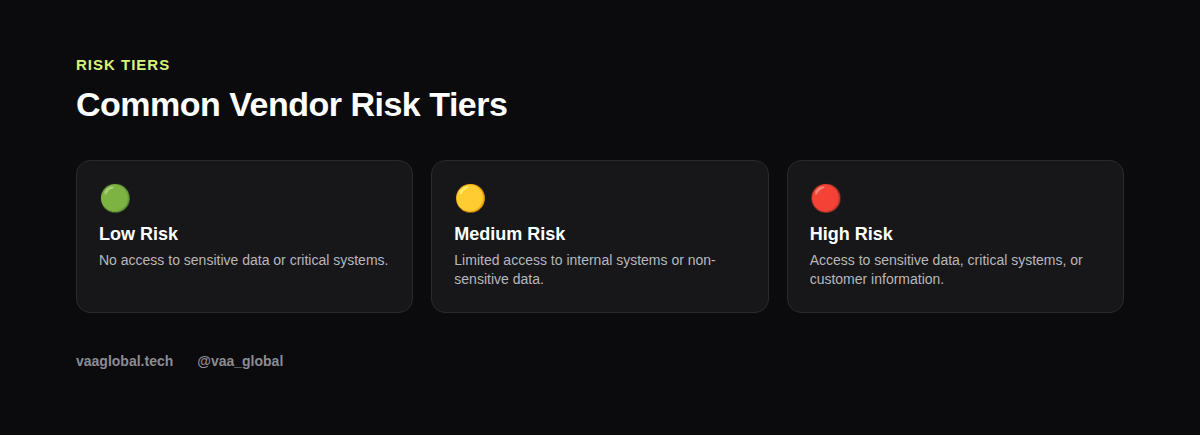
Not every vendor deserves the same scrutiny. A company providing office snacks poses a very different risk than a payment processor handling customer card data, so most mature programs sort vendors into tiers, as shown in the graphic below, and focus their deepest reviews on the highest-risk tier rather than spreading effort evenly across everyone.
Step Three: Building Protections Into the Contract
Contracting is where risk assessments turn into enforceable obligations. Security and data-handling requirements, breach notification timelines, audit rights, and clear data deletion obligations at the end of the relationship should all be spelled out rather than assumed. A handshake agreement doesn't hold up when something actually goes wrong.
Step Four: Monitoring Doesn't Stop at Onboarding
A vendor's risk profile at signing isn't fixed forever — ownership changes, security incidents happen, and a once-reliable vendor can quietly drift. Ongoing monitoring, whether through periodic reassessments, automated security ratings, or simply checking in on key vendors annually, catches that drift before it becomes a crisis. This connects directly to broader risk assessment basics: a vendor is just another risk that needs periodic re-evaluation, not a one-time checkbox.
Step Five: Offboarding Matters Too
When a vendor relationship ends, access needs to be revoked and data deletion confirmed, not just assumed. A surprising number of security incidents trace back to former vendors who still technically had access to systems or data long after the relationship officially ended. Treating offboarding as seriously as onboarding closes a gap that's easy to overlook.
Fourth-Party Risk: The Risk Behind Your Risk
Beyond your direct vendors, there's fourth-party risk — the vendors your vendors rely on. If your payroll provider outsources part of its infrastructure to another cloud company, that company's security posture matters to you too, even though you never signed a contract with them directly. Mature vendor risk programs at least ask vendors about their own critical subcontractors rather than stopping the inquiry at the first layer.
Concentration Risk: When Too Many Eggs Sit in One Basket
One more concept worth knowing is concentration risk — the danger of relying too heavily on a single vendor for something critical, with no viable backup if that vendor fails. A company whose entire payment processing, cloud hosting, and customer support all run through one provider has a convenient setup, but also a single point of failure that a well-run vendor risk program should flag and actively manage, even if switching providers isn't realistic in the short term. NIST's guidance on supply chain risk management, available at nist.gov, touches on this kind of dependency risk as part of the broader cybersecurity risk picture.
Common Questions Beginners Ask
People often ask why is vendor risk management important — because a vendor's weaknesses can become your weaknesses the moment you share data or system access with them. On how do you assess a new vendor's risk, the short answer is a combination of questionnaires, requested evidence like audit reports, and risk tiering based on data sensitivity and access level. People also ask what happens when offboarding a vendor, which, as covered above, should include access revocation and confirmed data deletion. And is vendor risk the same as supply chain risk — they overlap heavily, though supply chain risk sometimes extends further into physical goods and logistics concerns beyond just data and systems.
Why This Matters for Your Career
Vendor risk management is a concrete, in-demand skill across GRC, procurement, and operations roles alike. If you're building toward this kind of work, pairing it with a working knowledge of a risk register and basic risk assessment will let you demonstrate the whole process end to end in an interview. Our guides on what is a risk register and how to build one and key metrics every operations manager should track are good next reads, and VAA Global's Business Analysis course covers requirements elicitation and solution evaluation skills that overlap with how vendor needs get assessed in the first place.
The Bottom Line
Third-party vendor risk management basics come down to a simple rhythm: assess before you sign, tier your vendors by actual risk, bake protections into the contract, keep monitoring after onboarding, and close the loop properly when the relationship ends. Master that rhythm, and you'll have a skill that applies across almost every industry.