
Anyone exploring privacy and compliance topics eventually asks about HIPAA vs GDPR, what's the difference, usually because the two acronyms get mentioned in the same breath without much explanation. They protect different things, in different places, under different legal systems — but they share more common ground than most beginners expect.
HIPAA, in Brief
HIPAA (the Health Insurance Portability and Accountability Act) is US legislation that protects protected health information, usually called PHI. It applies to covered entities like healthcare providers and health plans, plus their business associates — vendors and partners who handle PHI on their behalf. For the authoritative source on HIPAA requirements, see hhs.gov. If you're specifically interested in how HIPAA applies to remote healthcare support roles, our HIPAA beginner's guide for medical virtual assistants covers that angle in more depth.
GDPR, in Brief
GDPR (the General Data Protection Regulation) is EU legislation protecting personal data across every sector — not just health data, but financial, employment, marketing, and more. It applies based on whose data is being processed, so companies well outside the EU can still fall under its reach if they handle EU residents' data. Our separate guide on GDPR compliance basics for GRC beginners walks through the core principles in detail.
Scope: Health Data vs. All Personal Data
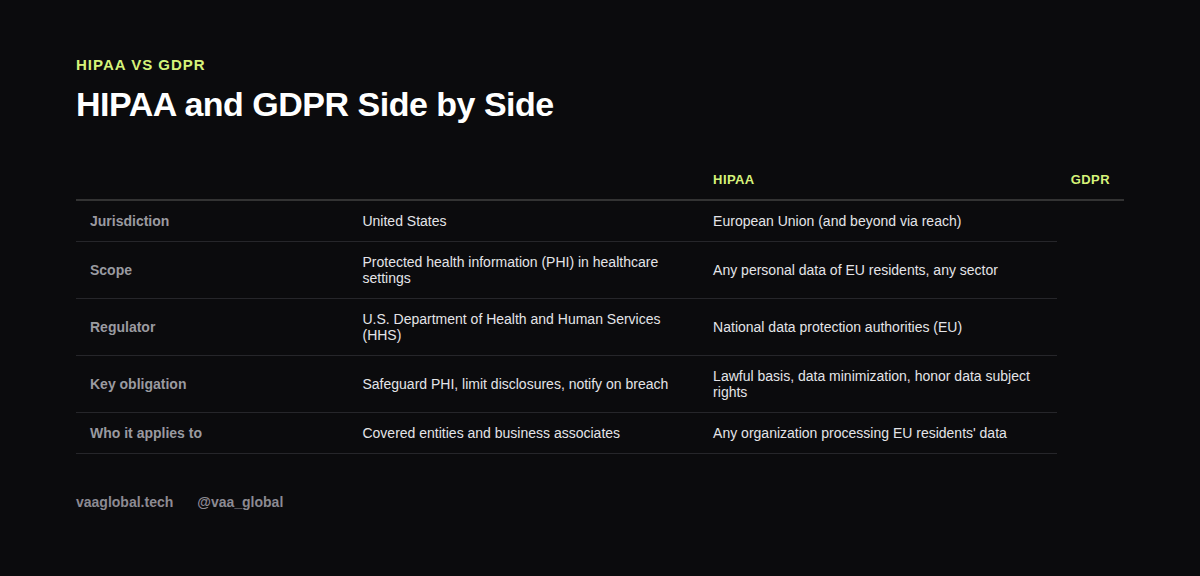
The biggest structural difference is scope. HIPAA is narrow and deep — it focuses entirely on protected health information within the healthcare ecosystem. GDPR is broad and sector-agnostic — it covers any personal data, from a customer's email address to their biometric data, across virtually any industry. A hospital in the US might only need to think about HIPAA; a hospital in the US treating patients from the EU might need to think about both.
Jurisdiction and Enforcement
HIPAA is enforced domestically within the United States by the Department of Health and Human Services. GDPR is enforced by national data protection authorities across EU member states, and because of its extraterritorial reach, organizations well outside the EU can still be investigated if they process EU residents' personal data. This is one of the more surprising facts for beginners: geography doesn't fully determine which law applies.

Where the Two Actually Overlap
Despite their differences, HIPAA and GDPR share real common ground. Both require appropriate security safeguards for sensitive personal data. Both include breach notification obligations when something goes wrong. And both extend responsibility to third parties — HIPAA through the business associate agreement, GDPR through contracts between data controllers and data processors. If you're curious how that third-party piece works in practice, our guide on the business associate agreement for medical virtual assistants is a concrete example from the HIPAA side.
A Worked Example: One Company, Both Laws
Picture a US-based telehealth company that also serves patients traveling in Europe. For its US patients, it needs HIPAA-compliant handling of protected health information. For any EU-resident patients, it also needs a GDPR-compliant lawful basis for processing, clear privacy notices, and a way to honor data subject rights like access and erasure requests. Running both programs side by side, rather than assuming one automatically satisfies the other, is exactly the kind of gap a GRC analyst gets hired to catch.
Common Questions Beginners Ask
People often ask does HIPAA apply in Europe — no, HIPAA is US law and doesn't extend there directly, though a US company operating internationally might still need to comply with both laws for different parts of its data. On does GDPR cover health data, yes, health data actually gets extra protection under GDPR as a 'special category' of personal data requiring stricter handling. People also ask which is stricter, HIPAA or GDPR — it's not really an apples-to-apples comparison since they cover different scopes, though GDPR's broader reach and individual rights framework often feels more expansive to newcomers. And can a company need to comply with both HIPAA and GDPR — absolutely, as shown in the telehealth example above.
Consent and Legal Basis: A Subtle Difference
One more nuance worth knowing: GDPR generally requires a specific lawful basis for processing personal data, and consent is only one of several options available, alongside things like contractual necessity. HIPAA works differently; it permits covered entities to use and disclose PHI for treatment, payment, and healthcare operations without needing fresh consent for every single instance, while still restricting most other disclosures. That difference in how 'permission' works is a common source of confusion when someone trained under one framework starts working with the other, so it's worth sitting with rather than assuming the two systems map one-to-one.
Why This Comparison Matters for Your Career
Understanding how privacy laws differ and overlap is a genuinely marketable GRC skill, especially as more companies operate across borders. If you're coming from a healthcare support background, you might also find our piece on what to do after a HIPAA mistake useful for grounding these legal concepts in day-to-day practice.
The Bottom Line
When it comes to HIPAA vs GDPR, what's the difference boils down to scope and jurisdiction — one is a focused US health-data law, the other a broad EU data protection regulation with global reach. Learn both frameworks' core obligations, and you'll be well positioned for compliance work that increasingly spans more than one country at a time.