
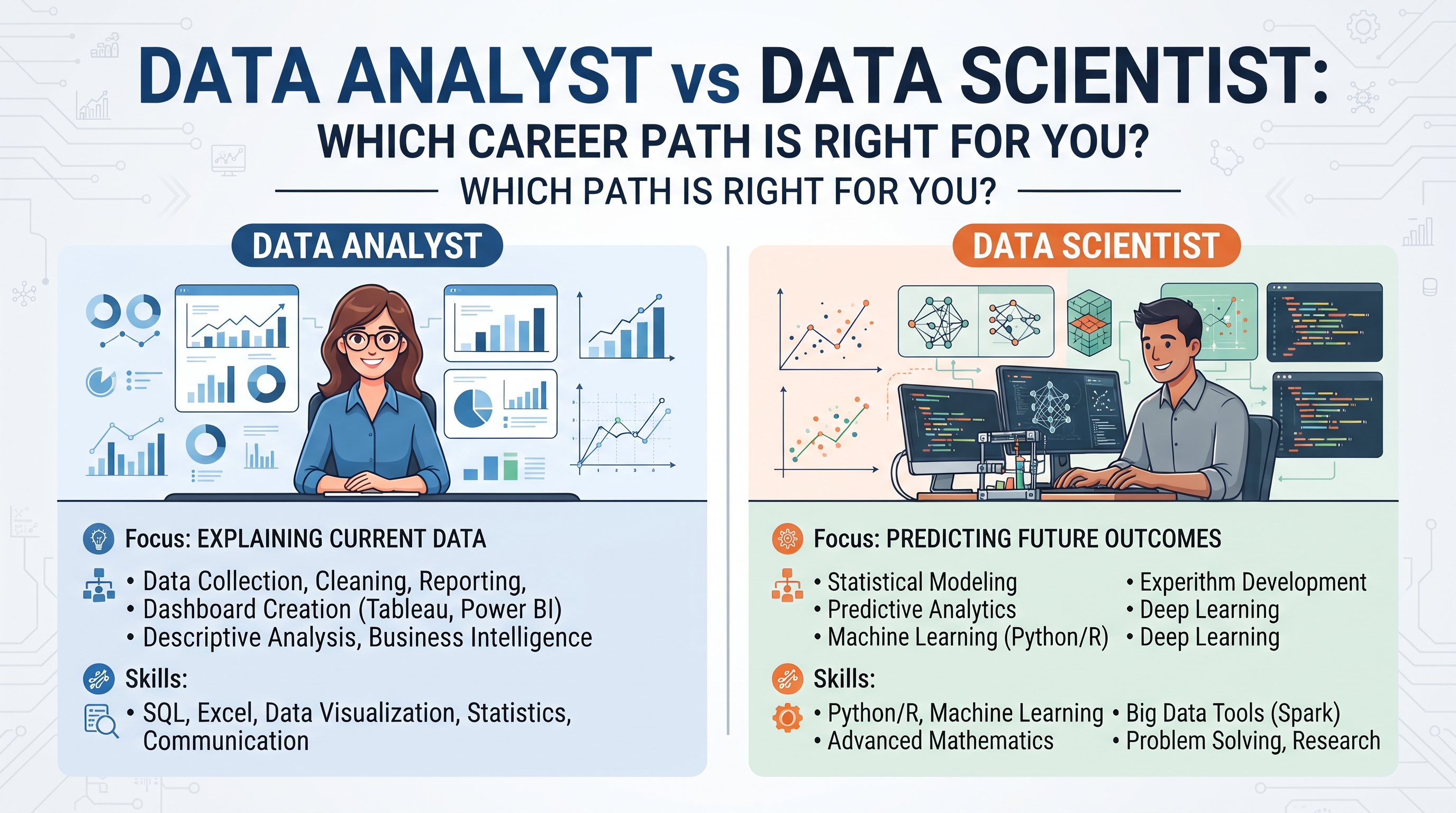
The Core Difference, In Plain Terms
A data analyst answers the question "what happened, and why?" using existing data, cleaning it, querying it, and presenting clear findings through dashboards and reports. A data scientist goes a step further, answering "what's likely to happen next?", building predictive models using statistical methods and programming, typically Python.
Put simply: analysts explain the past and present clearly, scientists build tools to forecast the future. Both are valuable, and both are in demand, but they draw on meaningfully different day-to-day skill sets.
What Data Analysis Actually Involves
The core toolkit is Excel, SQL, and a visualization tool like Power BI or Tableau, cleaning messy data, writing queries to pull what you need, and building dashboards that make findings clear to non-technical stakeholders. It's a genuinely accessible entry point into the data field.
What Data Science Adds on Top
Data science layers in predictive modelling, building statistical or machine learning models that forecast outcomes rather than just describing what's already happened. This typically requires learning Python, working with libraries like Pandas, and understanding statistical concepts more deeply, feature engineering, model accuracy, hypothesis testing.
How VAA Global Supports Either Path
VAA Global offers both as separate, focused courses. The Data Analysis course runs 10 weeks covering data cleaning, SQL, dashboard building, and visualization. The Data Science course also runs 10 weeks, covering data wrangling, predictive modelling, statistical analysis, and feature engineering using Python and Jupyter Notebook.
Both include a 2-month internship, 2 certificates, and job placement assistance, so whichever path fits you better, you graduate with real, demonstrable experience, not just theoretical knowledge.
How to Actually Decide Between Them
If you're drawn to clear, immediate problem-solving, understanding why a metric moved, building a dashboard someone actually uses, start with data analysis. If you're drawn to prediction and pattern-finding, and comfortable investing more time in learning statistical methods and Python, data science may be the better long-term fit.
If you're genuinely unsure, VAA Global's free Career Compass quiz can help clarify which path fits your interests and goals better before you commit.
Common Mistakes Beginners Make in This Field
A common beginner mistake is jumping into building predictive models before genuinely understanding the underlying data, which produces models that look sophisticated but are built on flawed assumptions. Good data science, like data analysis, still starts with thorough data understanding, not shortcuts to the exciting part.
A second mistake is chasing model complexity for its own sake, when a simpler, more interpretable model would actually serve the business need better. A model nobody can explain or trust is often less useful than a simpler one stakeholders actually understand and act on.
A third mistake is treating Python fluency as separate from statistical thinking, when the two genuinely need to develop together. Code without statistical understanding produces technically working but conceptually flawed analysis.
What Your First Few Weeks Actually Look Like
Early weeks in VAA Global's Data Science course focus on data wrangling and Python fundamentals, building the technical foundation the rest of the course sits on.
The middle weeks bring in statistical analysis and feature engineering. The final weeks cover predictive modelling, building a real project, before the 2-month internship.
It's also worth understanding that both paths reward genuine intellectual curiosity, being comfortable not immediately knowing the answer and enjoying the process of finding it through data, rather than expecting certainty from the outset, which matters more to long-term success in either field than raw mathematical talent alone.
This same discipline, methodically comparing options with real data, applies just as much to the analyst-versus-scientist decision itself, testing which type of work you genuinely enjoy through real practice matters more than choosing based on job titles or salary alone.
Beyond the technical skills themselves, both paths also reward the ability to communicate findings clearly to people who aren't data specialists, since even the most sophisticated analysis or model delivers little value if the people who need to act on it can't understand what it's actually telling them.
Once you're genuinely job-ready, VAA Global Talent at talent.vaaglobal.tech connects graduates directly with employers actively hiring for exactly this kind of skill.
VAA Global's free CV and LinkedIn review tool at vaaglobal.tech/cv-review can also help you present this experience clearly once you're ready to apply.
Research from GitLab Remote Work Report backs this up, consistently finding that this pattern holds across the wider remote job market, not just as an isolated trend.
This isn't just anecdotal either, Upwork Freelance Forward Research has published findings that point in exactly the same direction.
World Economic Forum Future of Jobs Report has tracked this pattern closely, and their findings reinforce exactly the point made here.
Choosing Your Path
Neither path is objectively better, they're different tools for different problems. Once you've decided, you can apply to VAA Global's Data Analysis or Data Science course and start building real, job-ready skills.